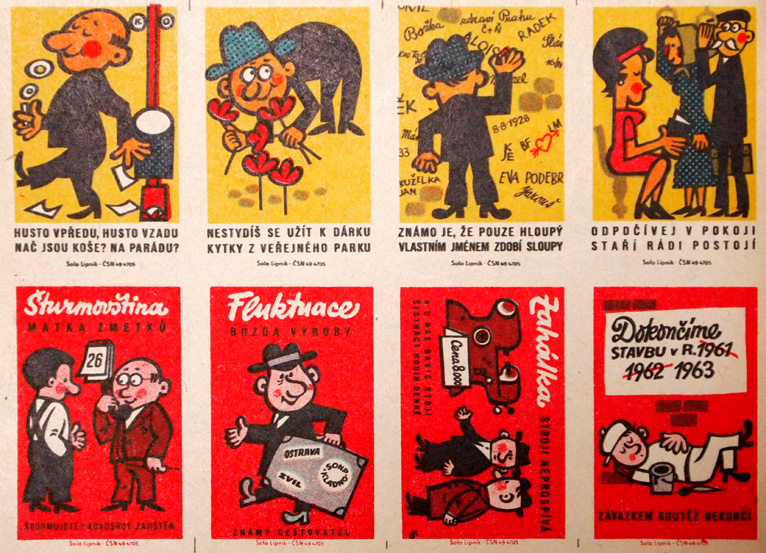
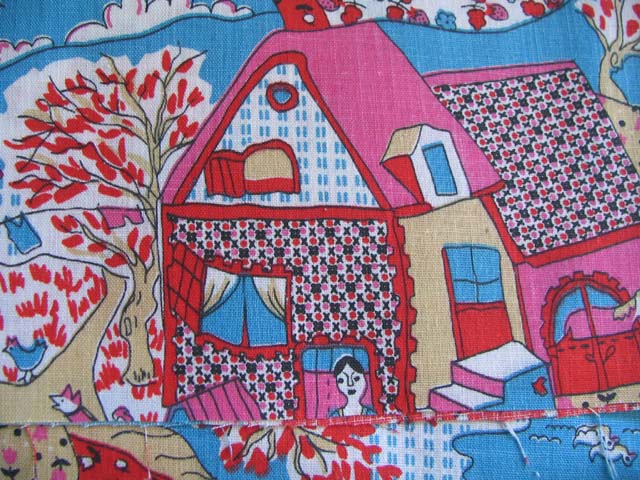
No I didn't know what it was either, but Phillumeny is the proper name for matchbox label collecting.
I've seen lots of images of Eastern European labels doing the rounds on Pinterest, and thought I'd start a little collection of my own. I was thrilled with these first sheets that I got from Ebay, I'm properly hooked now, I want more!
This collection on Flickr has some absolute gems. These designs by French artist Nathalie Lété are also calling to me.
I've just discovered the wonderful illustrations of Finnish children's author Oili Tanninen. I love the simplicity of the black outlines on bright backgrounds. I also found this lovely B&W animation, complete with spine-tingling Finnish narration, kooky sound effects and quirky music.
I'm gatecrashing Jaboopee's meme today. I've been wanting to do a "what inspires me" post for a while, and this seems a nice way of doing it. The idea is that you list seven aesthetic themes in your work - showing some examples, and then how they feature in your work. I'm not sure I've got seven, but I'll get started and see how we go...
1) A 1970s Childhood We're talking Dick Bruna, FisherPrice, Bod, Meg and Mog, Playmobil, Topsy and Tim. Those strong, simple designs with their black outlines and bright colours translate to stained glass so well.
2) Retro Fabrics I never get tired of gingham. Ever. It just always looks so fresh and fun and girlish. As soon as I learnt how to acid-etch glass, I used that technique to make gingham. Back in the old days, when I lived in London, we lived around the corner from Cath Kidston's first shop in Clarendon Cross. This was in the days before she was a household name and had sold her soul to Debenhams (sorry Cath) when it was a quirky little shop selling lovely things and the catalogue was a couple of photocopied hand-drawn sheets of A4 (cue harp music and misty eyed nostalgic moment). I digress. Around this time was when I started learning the various techniques of manipulating sheet glass, and the first pieces I made were pretty much homage to the fabric designs of La Kidston. I was also (much to the amusement of my OH) spending a lot of time hanging round the Imperial War Museum and using up my ration coupons. Once I'd worked my way through cabbage roses and floral sprigs, I moved on to abstract designs of the 50s and 60s - Lucienne Day and Evelyn Redgrave. I love the challenge of trying to recreate fabric designs in stained glass. The limitations of the medium are also what make it so addictive. Images from here, here and here
3) Scandinavian Folk Art Bold colours, simple designs, repetitive patterns, flourishes, symmetry, flowers, birds. Of course. Images from here, here and here
Well, as much fun as this is, it is also taking up all of my Friday night. So Part Two follows soon....
Yes, I thought so. Me too. How did I not know about True Up before?
I was researching mid-century farm imagery for a small panel I'm doing (a partner for Cockerel #3 - they were so pleased with it they want to order another...a cow this time). Here's just some of the bounty I found via True Up... from janssendesigns
I forgot to share with you tales of my Ikea trip. Hmm, well, there aren't many actually (unless you count my complete ineptitude on the trolley front) but my favourite purchase has to be this duvet cover. My, that is one sweet sweet pattern, and fits so nicely in our spare room.
It seems to have borrowed quite heavily from a design called Cascade by Evelyn Redgrave for Heals (circa 1965)... ...but that's ok, I did the very same a couple of years back for a commission. The brief was for a stained glass panel to go in a lightbox as a wedding gift (the happy couple were due to move house, so it needed to be portable) They had a love of all things 1960s so the idea was to recreate a fabric design in stained glass.
This is the result. The effect of having it in a lightbox was quite incredible. The room literally filled with joy when we turned it on. When we turned it off, we all felt just a little bit sadder somehow. I have to say, I LOVED making this window. The construction was very complex, and there was no margin for error in the cutting of the glass, so it was pretty intense stuff. But so enjoyable and satisfying getting those smooth curves in the lead.